Words by Matt Sephton
In March, I released my debut album, Vā, an 11-track work created in Samoa from field recordings, found sounds and collaborations, woven together with bass-heavy electronic production. I’m genuinely proud of it – partly because I love the music itself, but also because it marks a fundamental shift in my creative practice. It is a move toward place-based work and away from the typical bass heavy party music I release and perform under my DJ alias, Matt Rapid.
Vā came together during a residency at the Tiapapata Art Centre in Samoa. My wife, ceramic artist Caitlin Moloney, and I spent two and a half months there last year after stumbling across the centre while on holiday in 2023. It’s a lush, lively space high in the hills above Apia, away from the resorts, where every day there’s activity between the cafe, gallery, dojo, and creative studios. We made it our mission to return as artists. For Caitlin, it was a chance to work with local clays in a tropical environment; for me, I wasn’t entirely sure what I’d be doing at first.
I knew I’d be recording, but I certainly hadn’t gone there planning to make an album. The aim was pretty simple: we both wanted to step outside our usual routine and see what might happen in a different environment, to challenge ourselves with the space and freedom the residency offered.
With that room to explore, I found musical ideas came together much faster than I was used to. After a few weeks, a cohesive body of work started forming, new compositions were growing out of field recordings and nature sounds. My mission shifted firmly to creating a new body of work rooted in that particular place and time, while Caitlin immersed herself in the creation of a single incredible ceramic work titled Skin .
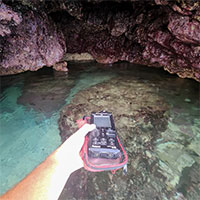
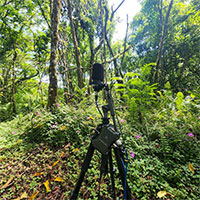
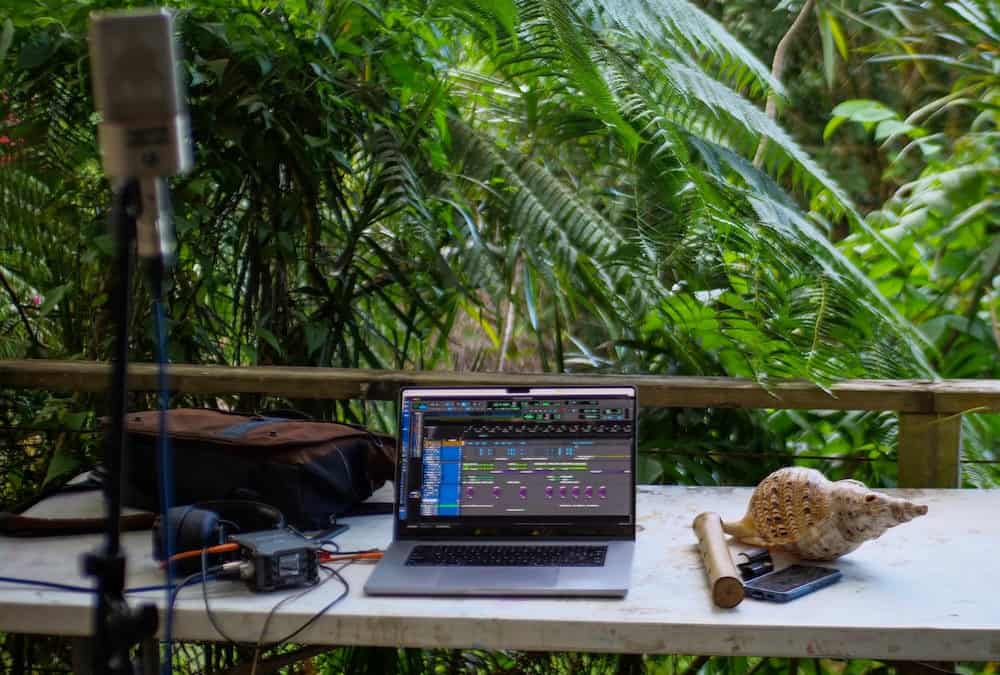
Vā began with listening, and I spent more time recording than composing – capturing fragments of voice, sounds around the art centre, underwater sounds – these became the foundations to work from. I had my audio recorder with me wherever we went, using stereo mics and a DIY hydrophone to find interesting sounds, especially the beautiful hidden sounds found underwater.
Non-musical sounds interest me most because they carry no expectations; they are full of random unexpected moments, maybe an animal noise, bird call or distant singing, these moments can become features rather than flaws. I would sift through hours of audio to find the interesting and unexpected parts, making them drum hits or melodic motifs. It’s a really fun process – time consuming, yes – but when a piece of music comes together, starts feeling cohesive and alive, that is so satisfying. I also have hours and hours of unused recordings. Sometimes the best part is simply going somewhere and listening. The technical process was as much about discovery as production, exploring new forms and methods, finding unique sonic textures.
In “Clay,” I used the hydrophone to capture dry clay collapsing in water. As it hit the water the clay comes alive, fizzing with clicks, pops and squeals. That simple capture became a piece that held far more weight than I expected. It’s a track I absolutely love, and one of the simplest tracks on the album, letting the wild sound of the clay do the heavy lifting.
Other tracks were shaped by collaborations with people we met there: “Horizon” shifted completely when Tau’ili’ili Alpha Maiava added his incredible fagufagu (nose flute) we had a really great session recording in his home, sitting around the kitchen table chatting about music, colonialism, the impact of the church on Samoa’s history, and recording these stunning sounds. This steered the track – which was already more or less finished – into an entirely new direction, toward a beautiful meeting of sonic worlds – ancient sounds, and bass heavy modernism. In the papermaking studio, Awal Muhammed’s voice became the entry point for “Paper,” paired with the soft tactile sounds of his hands on handmade paper before unfolding into a fast, shuffling drum and bass rhythm.
There are so many great sounds through the album, and for me listening back I am instantly transported back to those moments, for Caitlin and I it’s like a visceral sonic journal. Opening track ‘Floating’ is built around a hypnotically swirling eddy in a creek we’d go swimming in, an underwater rhythmic repetition.
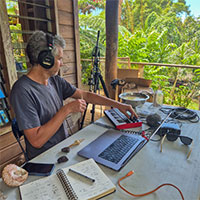
Every track was created during the residency, I’d be working in both Ableton live and Pro Tools software, using the best of both programmes to build the music up, layering sounds as I went. Although the mixing and editing happened later, when we’d returned home, I had to resist the urge to bring in new ideas. It felt vital to keep the work anchored to that specific window of time, preventing it from stretching into something more diffuse.
Since its release, Vā has found its way into the world, debuting on the Official Aotearoa Music Charts in April – a heartening sign that these specific, local sounds were reaching a wider audience. The live shows pair the music with slow, textural footage from the residency, extending that same sense of immersion.
Vā is the first chapter in what I hope will be an ongoing practice of place-based music making, each project rooted in a specific location, made in collaboration with people and environment. And so this feels like a wonderful new beginning. The process has changed how I think about making: it is less about control and fitting into a genre, and more about paying attention to the sounds and following whatever threads and ideas emerge. The intention now is to continue working in this way, in different places, and see what comes from that.